Best DCF Calculator for Retail Investors
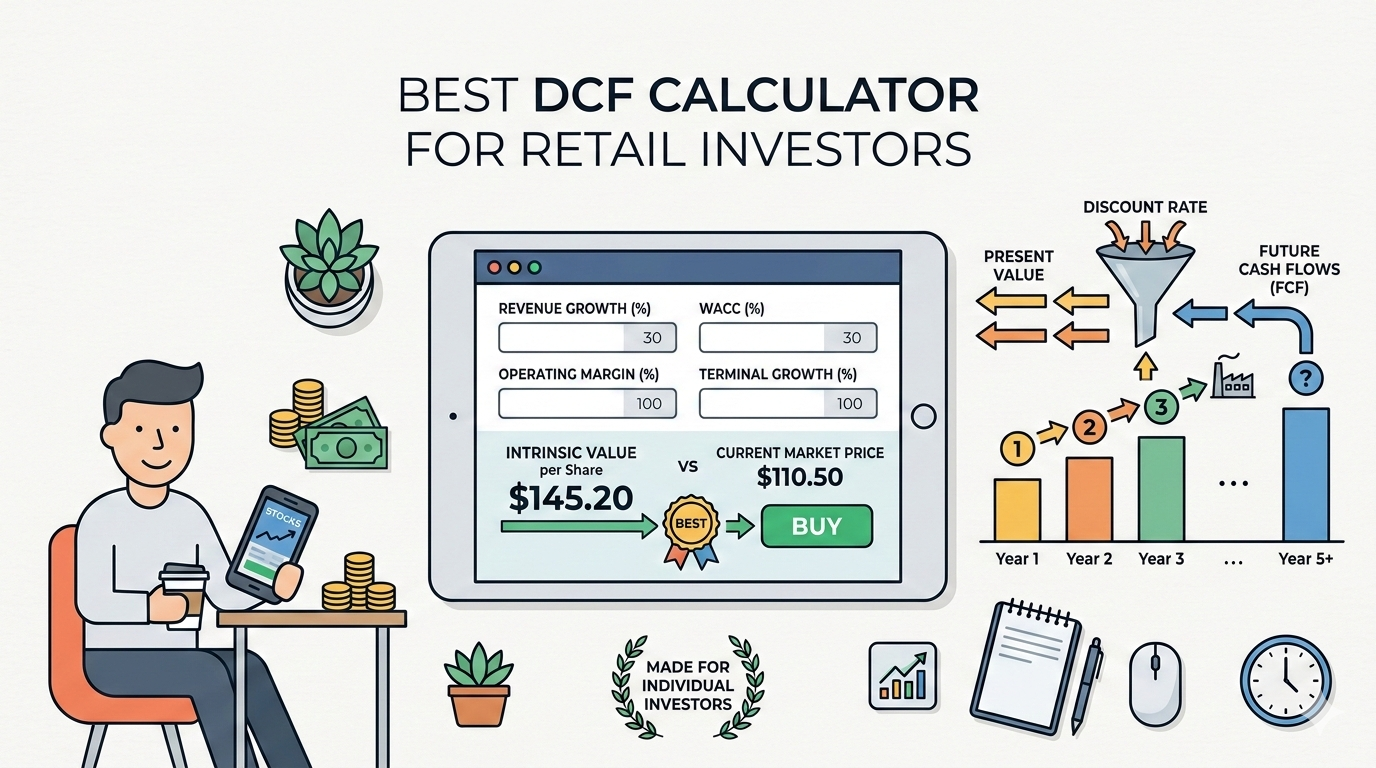
The best DCF calculator is transparent, scenario-friendly, and disciplined—so retail investors can estimate intrinsic value with confidence.
Intrinsic Alpha
Value Investing Research
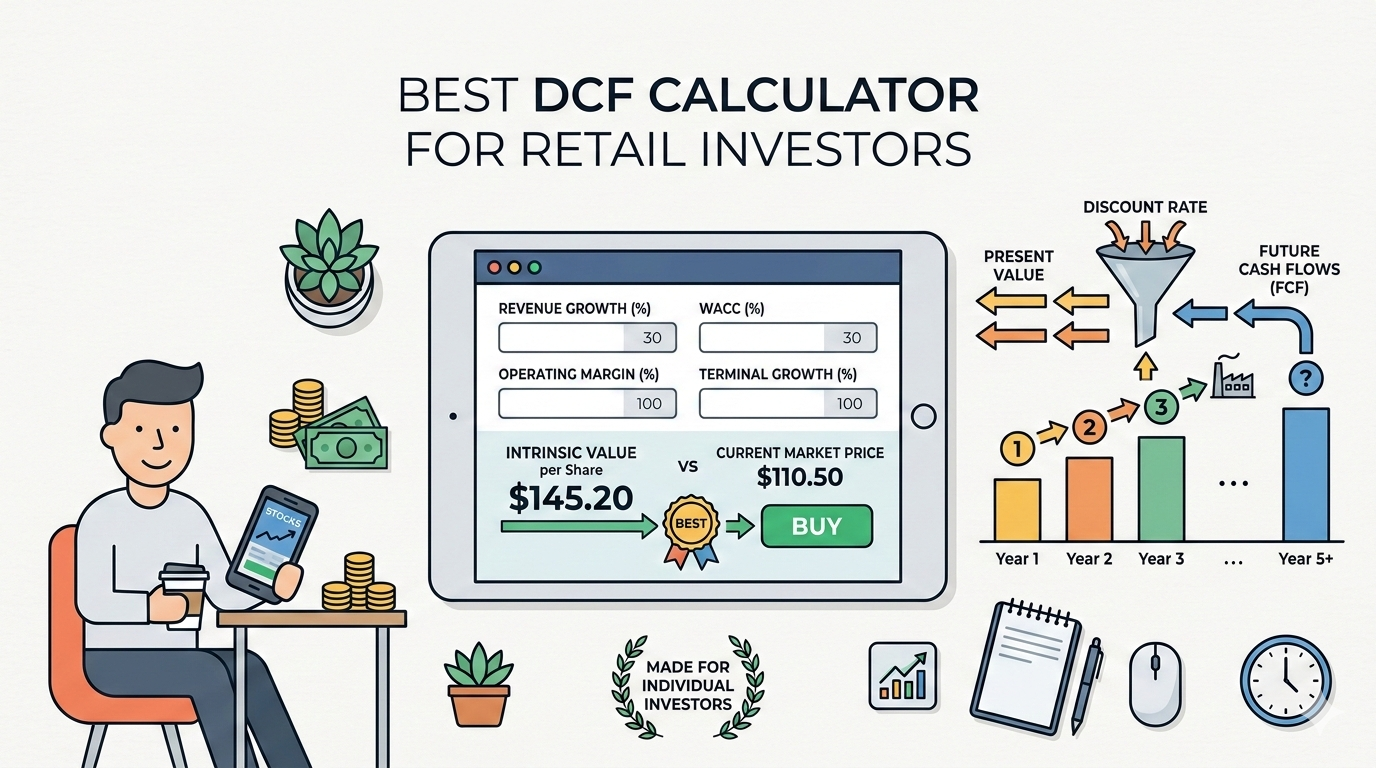
You don’t need a “fancier” DCF.
You need a dcf calculator that stops you from lying to yourself.
That’s the real pain point for retail investors: most discounted cash flow calculators make it easy to plug in optimistic numbers, get a beautiful intrinsic value, and feel smart—right until the stock keeps falling.
This guide shows what actually matters in a DCF tool for value investing: transparency, scenario thinking, and a workflow that makes you consistent across dozens of companies.
A DCF calculator is “best” when it makes your assumptions explicit, shows uncertainty (bear/base/bull), and prevents you from hiding risk in the terminal value.
What makes a DCF calculator “best” for value investing?
The best DCF calculator isn’t the one with the most inputs.
It’s the one that produces a valuation you can explain, defend, and repeat next week with the same rules.
Here’s the standard you should hold it to:
- You can audit every assumption (no hidden formulas).
- You can explore uncertainty (bear/base/bull isn’t optional).
- It forces discipline (guardrails beat infinite customization).
The 5-Layer DCF Confidence Stack (retail investor edition)
Most DCF calculators focus on features. A better way to evaluate them is by confidence layers.
If a tool fails early layers, extra knobs don’t help.
Layer 1: Transparent cash flow definition
Your DCF is only as honest as the cash flow you discount.
At minimum, your calculator should clearly state which cash flow is used (and let you choose it intentionally):
- FCFF (Free Cash Flow to the Firm): values the enterprise, then adjusts for net cash/debt.
- FCFE (Free Cash Flow to Equity): values equity directly, but demands cleaner financing assumptions.
If a tool can’t answer “What exactly is being discounted?” it’s a black box.
In practice, open a real valuation page and look for the cash flow label before you touch any assumptions. For example, on the Coca-Cola valuation page, you should be able to tell whether you’re discounting firm cash flows (enterprise value) or equity cash flows (equity value)—and why.
Layer 2: Discount rate you can justify
For retail investors, the goal isn’t to compute a perfect WACC.
The goal is a defensible required return that matches your opportunity cost and the business risk.
Your DCF tool should make it obvious:
- What discount rate is used (and whether it’s nominal vs real)
- Whether assumptions change by scenario
- How sensitive intrinsic value is to the rate
Concrete check: pick a high-quality mega-cap like Microsoft and ask, “If I move the required return by 1–2%, how much does intrinsic value move?” If the tool doesn’t make that sensitivity easy to understand, you’ll over-trust the output.
Layer 3: Terminal value clarity (and constraints)
Terminal value is where weak DCFs go to hide.
A strong DCF tool makes terminal assumptions explicit and constrained:
- Perpetual growth method (with a growth cap)
- Exit multiple method (with a sanity range)
- A visible share of value coming from the terminal period
If 70–90% of value is terminal, that doesn’t automatically mean “wrong.” It means you must treat the result as fragile.
Try this on a mature cash generator like Apple: if most of the value is coming from the terminal period, the result is telling you “your assumptions beyond year 5–10 dominate the answer.” A good calculator forces you to see that.
Layer 4: Scenario analysis that’s fast and comparable
DCF is sensitive; pretending it’s precise is the fastest path to overconfidence.
Your calculator should support bear/base/bull scenarios without copying spreadsheets:
- One click to switch scenarios
- Side-by-side comparison
- Clear list of what changed (growth, margins, reinvestment, discount rate)
This is how you stay consistent across stocks.
Here’s what “fast scenarios” looks like in real life: you should be able to open AAPL, set bear/base/bull by changing only the 2–3 biggest drivers (usually growth, margin, and required return), and then repeat the same process on KO without rebuilding the model.
Layer 5: Equity bridge to per-share intrinsic value
Retail investors buy shares, not “enterprise value.”
So the tool must show the full bridge:
- Enterprise value → equity value adjustments (cash, debt, other claims)
- Shares outstanding (and whether dilution is considered)
- Per-share intrinsic value and your implied margin of safety
If you can’t reconcile the output to a per-share number you trust, it’s not investable.
The tell is the bridge: enterprise value → net cash/debt → other claims → equity value → diluted shares → per-share intrinsic value. If any step is hidden, you’re trusting a black box.
A quick “best DCF calculator” test you can run in 3 minutes
Don’t look for a “right intrinsic value” number.
Look for a model you can audit: cash flow definition → discount rate → terminal value → equity bridge → per-share value.
- Cash flow definition: can you clearly see FCFF vs FCFE?
- Discount rate: can you explain it in one sentence and stress it by ±1–2%?
- Terminal value: is the method explicit and constrained (growth cap / sanity range)?
- Equity bridge: can you reconcile enterprise → equity → diluted shares → per-share value?
- Scenarios: can you switch bear/base/bull without copying the entire model?
Use one mega-cap and one steady consumer business so you can compare your workflow apples-to-apples.
If you want a simple set of real-company reps to test your workflow, use one mega-cap and one steady consumer business:
The counter-intuitive rule: the best DCF calculator limits you
Here’s the veteran move that feels backwards at first:
More customization usually makes your DCF worse.
Why? Because unlimited freedom lets you “tune” the model until it matches what you want to be true.
Look for a DCF tool that encourages:
- Fewer high-leverage inputs (growth, margins, reinvestment, discount rate)
- Ranges instead of single-point guesses
- Guardrails (e.g., terminal growth caps, margin ceilings, reinvestment reality checks)
In value investing, your edge is not precision.
Your edge is process.
Advanced tip: use a Reverse DCF before you build your forward DCF
Most investors do a forward DCF and ask, “Is the stock undervalued?”
Flip it first.
A great discounted cash flow calculator makes it easy to run (or approximate) a reverse DCF:
Step 1: Start with today’s price
Treat the market price as the answer.
Step 2: Back into the assumptions
Ask: “What growth and profitability does this price imply?”
If the market-implied story already requires heroic execution, you’ve learned something important before you touch your own assumptions.
Step 3: Only then build your forward scenarios
Now your bear/base/bull cases have an anchor:
- Bear: “What if the implied story disappoints?”
- Base: “What if execution is merely good?”
- Bull: “What would have to go right to beat the implied story?”
This reduces narrative bias—and it’s one of the fastest ways retail investors can level up.
Reverse DCF mini-example (how to sanity-check price)
Pick a real company page, write down today’s price, then force yourself to answer one question:
What growth rate and profitability does this price require to be true?
- Open a live valuation page (e.g., AAPL).
- Write down the market price and the implied "story" (growth + margin).
- If the implied story already feels heroic, your forward DCF should start conservative.
Try it on a “priced for perfection” candidate and a steadier business:
If you want a starting point, run it on AAPL, then repeat on KO. The goal isn’t precision—it’s to see whether the market price already assumes an unusually good story.
A practical DCF workflow for retail investors
The best DCF tool fits the way you actually invest.
If you screen lots of stocks
You need speed and consistency.
Use a lightweight workflow:
- Run a quick reverse DCF to spot “priced for perfection” names
- Build a base case with conservative defaults
- Add bear/bull by changing only the 2–3 biggest drivers
- Save the scenario set so you can compare across companies
If you go deep on a few positions
You need auditability.
Prioritize:
- A clear model you can revisit (assumptions history)
- Notes on why you chose key inputs
- A valuation summary that highlights what drives the result
If you can’t explain your DCF in five minutes, you don’t understand it.
Red flags that make a DCF calculator dangerous
Avoid tools that:
- Hide formulas or don’t show the equity bridge to per-share value
- Let terminal growth float above a realistic long-term GDP range
- Pretend the output is precise (no sensitivity or scenarios)
- Mix up enterprise vs equity value without explaining adjustments
If the calculator won't show you how it gets from enterprise value to per-share value (cash/debt, other claims, dilution), treat the output as marketing—not analysis.
The risk isn’t “getting the wrong number.”
The risk is using a clean-looking number to justify a bad decision.
Conclusion: choose the DCF calculator that makes you disciplined
For value investing, a DCF calculator is not a prophecy machine.
It’s a decision tool—one that should make your assumptions explicit, your uncertainty visible, and your process repeatable.
If you want a DCF workflow built for retail investors—transparent inputs, fast scenario comparisons, and per-share outputs you can trust:
- Start Free Today and run your first pass on AAPL.
And if you have a favorite DCF method (FCFF vs FCFE, perpetual growth vs exit multiple), leave a comment with how you keep yourself honest.
The DCF checklist, in one place
Here's what a trustworthy DCF calculator gives you — and what Intrinsic Alpha was built around:
| What to check | Why it matters |
|---|---|
| Transparent cash flow definition (FCFF or FCFE) | You can't audit what you can't see |
| Justifiable discount rate with sensitivity | 1% change in WACC can swing value 20–30% |
| Constrained terminal value | Where optimism hides if you let it |
| Bear / base / bull scenarios in one click | Process beats precision |
| Full equity bridge to per-share value | Retail investors buy shares, not enterprise value |
| Margin of safety shown on output | Forces you to price in uncertainty |