How to Value a Stock Using Free Cash Flow
Learn how to value free cash flow like a professional investor. A step-by-step guide for retail investors to find intrinsic value and margin of safety.
Intrinsic Alpha
Value Investing Research
Most retail investors lose money not because they pick bad businesses — they lose because they pay the wrong price.
The antidote is not a hot tip or a screener shortcut. It is a disciplined method for turning free cash flow into a number you can trust. That number is intrinsic value, and it is the foundation of value investing that has compounded wealth for generations.
This guide walks you through how to value free cash flow from first principles — the same logic institutional desks use, translated into something any retail investor can apply tonight.
Why Free Cash Flow Is the Right Starting Point
Revenue flatters. Earnings can be engineered. Free cash flow cannot hide.
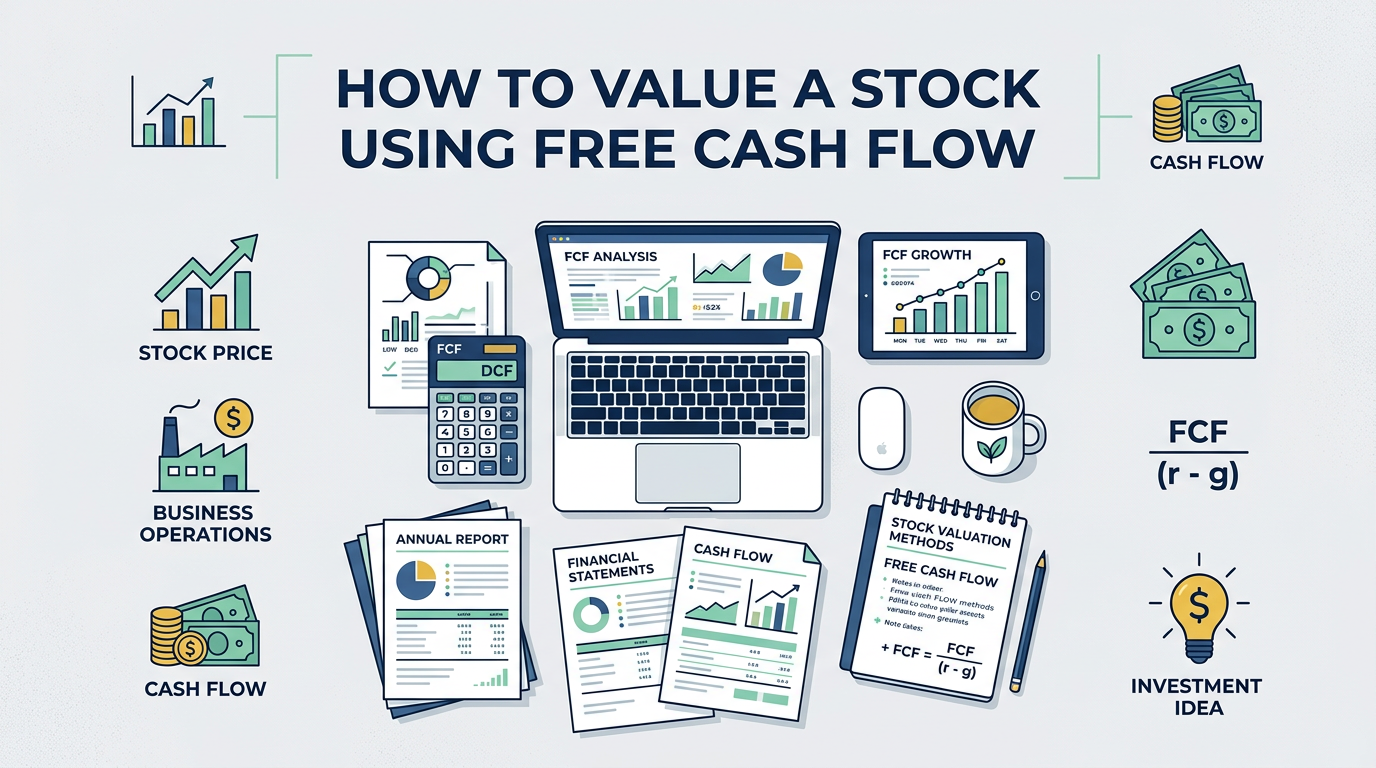
FCF is the cash left after a company has paid its bills and maintained its operations. It is what management can actually deploy — into dividends, buybacks, acquisitions, or debt reduction. If a company's earnings grow but its FCF shrinks, something is wrong. If FCF grows consistently, the business is genuinely creating wealth.
The formula is blunt and honest:
Free Cash Flow = Operating Cash Flow minus Capital Expenditures
That is it. No adjustments for stock-based compensation politics, no D&A add-back debates. Just cash in minus cash required to keep the machine running.
Step 1 — Calculate the Trailing FCF
Before projecting anything, anchor yourself to reality. Pull the last twelve months (LTM) of operating cash flow and subtract capital expenditures. Both figures live in the cash flow statement.
A few things worth checking:
- Working capital swings: A one-time inventory drawdown can inflate operating cash flow in a single year. Look at a 3–5 year average to normalize.
- Maintenance vs. growth capex: Not all capex is equal. If a retailer is expanding aggressively, strip out estimated growth capex to get a cleaner maintenance FCF.
- Stock-based compensation: Purists add it back; pragmatists leave it in. For retail investors, the conservative move is to leave it in — it dilutes you either way.
Step 2 — Build a Simple FCF Projection
You don't need a 40-tab model. You need reasonable assumptions and the intellectual honesty to stress-test them.
The Base Case
Project FCF over a 5–10 year horizon using a realistic growth rate. For a stable, mature business, 5–8% annual FCF growth is defensible. For a high-quality compounder with durable competitive advantages, 10–15% may be appropriate — but demand evidence before using it.
Ask yourself three questions:
- What has FCF growth averaged over the last five years?
- Are there structural tailwinds supporting continuation?
- What would slow or reverse this trajectory?
Never model your hopes. Model the business.
The Bear Case
Run a version where growth is half your base assumption. If the stock is attractive only in the optimistic scenario, the margin of safety is insufficient.
Step 3 — Discount Cash Flows Back to Today
A dollar of cash flow ten years from now is worth less than a dollar today. The discount rate captures that time-value and the risk of being wrong.
The basic formula in plain English:
Present Value of a Future Cash Flow = Future Cash Flow divided by (1 plus Discount Rate) raised to the power of the Year
Use a 10% discount rate as a clean benchmark — it approximates long-run equity market returns and acts as your personal hurdle rate. If an investment cannot beat 10% annually at current prices, you're not being adequately compensated for the risk.
Sum up all discounted cash flows across your projection window and add a terminal value to capture the business's ongoing worth beyond your forecast horizon.
Terminal Value = Final Year FCF multiplied by a Terminal Multiple
A conservative multiple of 15–20x final-year FCF is reasonable for quality businesses. Anything higher requires explicit justification.
Step 4 — Arrive at Intrinsic Value Per Share
Once you have the total present value of projected cash flows plus terminal value, subtract net debt (total debt minus cash on hand). Divide the result by diluted shares outstanding.
Intrinsic Value Per Share = (Sum of Discounted FCFs + Terminal Value minus Net Debt) divided by Diluted Shares Outstanding
This is your estimate of what the business is worth — independent of what the market is currently paying.
The Counter-Intuitive Insight: Run the Reverse DCF First
Most retail investors build a DCF forward and check if the result is above the current price. Experienced analysts do the opposite.
A reverse DCF starts with the current stock price and asks: what growth rate must the market be assuming for this price to be fair?
If a stock trades at $400 and you work backwards to find the market is pricing in 18% annual FCF growth for the next decade, you have a specific, testable claim. Now you only need to answer one question: is that growth rate realistic?
This reframes the investment decision from "what is it worth?" to "what does the market believe, and is that belief wrong?" That is the edge value investors look for — not superior models, but superior judgment about where consensus is mispriced.
Step 5 — Apply a Margin of Safety
Intrinsic value is an estimate. You will be wrong with some frequency. The margin of safety is your buffer against being wrong.
The standard framework:
- Buy at 25–35% below your intrinsic value estimate for quality businesses.
- Require 40–50% discounts for cyclical or capital-intensive businesses where FCF is harder to predict.
The margin of safety is not timidity — it is the mechanism that converts a correct thesis into an actual profit even when your assumptions were slightly off.
Common Mistakes That Destroy Returns
1. Using earnings instead of cash flow. EPS can be managed. FCF is far harder to manipulate.
2. Anchoring to last year's growth. Reversion to the mean is one of the most powerful forces in finance. Fast growers slow down. Assume it will happen earlier than you expect.
3. Ignoring dilution. If share count is growing 3% per year from stock-based compensation, your per-share FCF growth is materially lower than headline numbers suggest.
4. Underestimating the discount rate. In a higher-rate environment, the cost of capital rises. Deals that looked cheap at a 7% discount rate look mediocre at 10%.
5. Falling in love with the business. Quality is not a substitute for price. Even great businesses can be terrible investments at the wrong valuation.
What the Analysts Are Saying
Wall Street targets give you a useful sanity check — not as gospel, but as a reference for where informed professional money sits relative to your own estimate.
A significant gap between your intrinsic value and consensus targets is worth interrogating. Either you see something others have missed, or you've made an assumption that deserves a second look.
The Value Investing Checklist
Before any FCF-based valuation commits to a position, run through the fundamentals.
Conclusion — Price Is What You Pay, Value Is What You Get
The entire discipline of value investing collapses into a single decision: are you buying a dollar of earnings power for less than a dollar?
Free cash flow is the most honest measure of that earning power. A DCF built on realistic FCF projections, discounted at a sensible rate, with a genuine margin of safety embedded — that is not a guarantee, but it is the closest thing to a systematic edge available to retail investors.
The risk is not complexity. Anyone can run a basic DCF with a spreadsheet. The risk is overconfidence in your growth assumptions and impatience with a method that requires waiting for fat pitches.
Value free cash flow properly, demand a margin of safety, and let time do the compounding. The rest tends to take care of itself.
Intrinsic Alpha provides educational tools to help retail investors apply institutional valuation frameworks. This article is not investment advice. Always conduct your own due diligence before making any investment decision.