Why Intrinsic Value Matters More Than Stock Price
Stock price tells you what the market feels. Intrinsic value tells you what a business is worth. Learn why this distinction defines long-term investing success.
Intrinsic Alpha
Value Investing Research
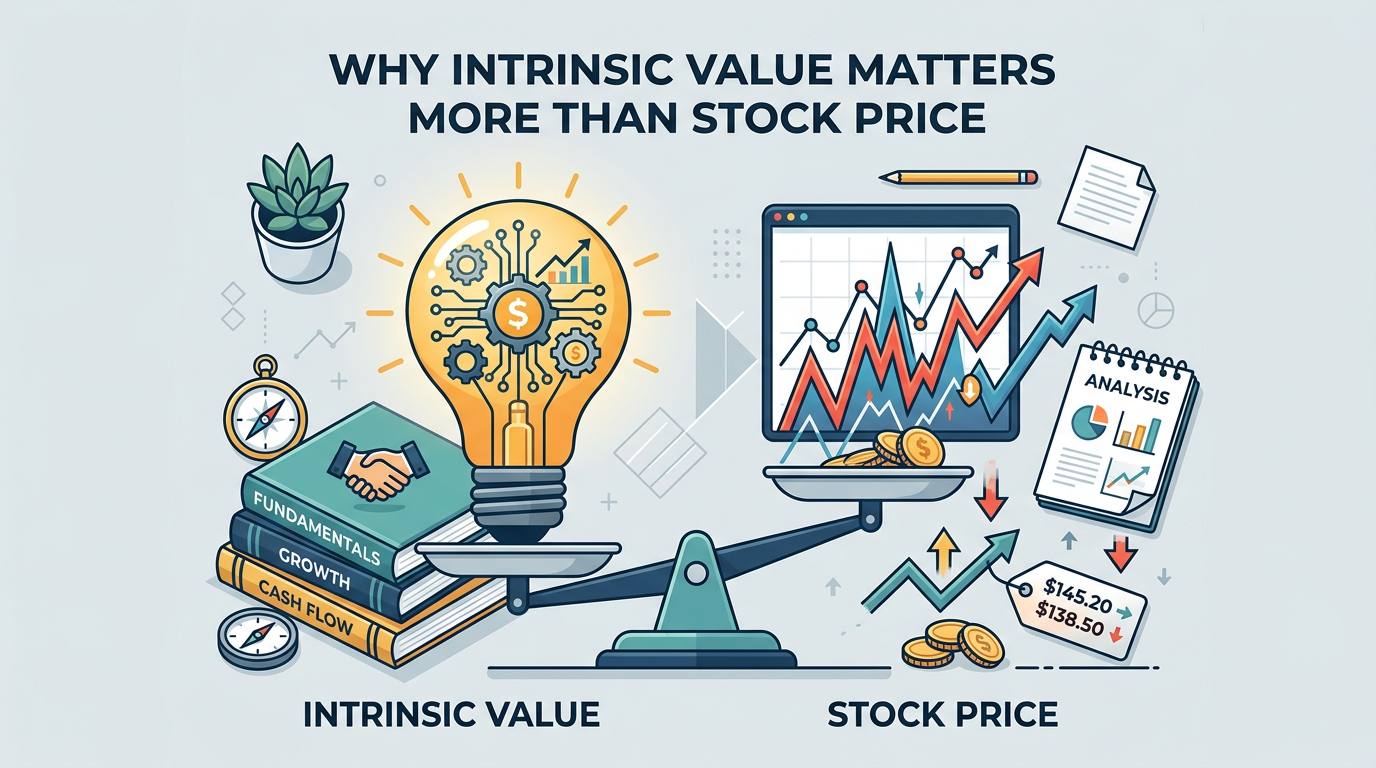
Most retail investors check their portfolio price first thing every morning. That habit — while understandable — is also the single biggest behavioral trap in investing.
Price is not value. Confusing the two is expensive.
The investors who have built lasting wealth — from Benjamin Graham to Warren Buffett to the best long-only funds operating today — share one discipline: they anchor every buy and sell decision to intrinsic value, not to the number blinking on a screen.
This article explains why intrinsic value is the only honest benchmark for making investment decisions, how retail investors can use it in practice, and why ignoring it is the most common way to buy high and sell low.
What Intrinsic Value Actually Means
Intrinsic value is the present value of all future cash flows a business will generate over its lifetime, discounted back to today at a rate that reflects risk.
In plain terms: it is what the business is genuinely worth to a rational buyer who intends to hold it forever.
The formula is simple to state and harder to estimate:
Intrinsic Value = Sum of (Future Free Cash Flows / (1 + Discount Rate) ^ Year) minus Net Debt
The discount rate reflects the minimum return you demand for bearing the risk of owning equity in that specific business. A highly predictable consumer staple earns a lower discount rate than a speculative growth company burning cash.
Why Stock Price Is Something Else Entirely
Stock price is the output of human emotion aggregated across millions of daily transactions. It reflects:
- Sentiment: fear, greed, momentum, and narrative
- Short-term earnings surprises relative to analyst consensus
- Macro noise: interest rate speculation, geopolitical headlines
- Liquidity flows: index rebalancing, ETF inflows, forced selling
None of these factors change the underlying cash flows a business will generate over the next decade. Yet they move stock prices by 2–5% in a single session routinely.
The stock market is a voting machine in the short run and a weighing machine in the long run. That quote, attributed to Graham, is still the most accurate description of how equity markets work.
The Dangerous Illusion of Price as Validation
Here is where retail investors get hurt most: they use a rising stock price as confirmation that a company is good, and a falling price as confirmation it is bad.
This is precisely backwards from how institutional value investors think.
When a stock falls 20% and the underlying business fundamentals are unchanged, the intrinsic value calculation has not changed. The margin of safety — the gap between what you pay and what the business is worth — has actually improved. That is when buyers should be interested, not frightened.
When a stock rallies 40% with no change in fundamentals, the margin of safety has compressed. Risk has increased, even though the price action feels rewarding.
Buying conviction should come from your valuation model, not from a price chart moving in the right direction.
How Retail Investors Can Anchor to Intrinsic Value
You do not need a Bloomberg terminal or a PhD to build a grounded view of intrinsic value. You need three inputs and a willingness to think in ranges rather than false precision.
Step 1: Estimate Normalized Free Cash Flow
Start with the most recent three-to-five year average of free cash flow. Normalize for one-time items and working capital distortions. This is your base-period cash flow.
Step 2: Project a Growth Rate You Can Defend
Do not extrapolate the last three years of growth blindly. Ask:
- Does this company have durable pricing power?
- Is the total addressable market expanding or contracting?
- Is management reinvesting capital at high returns, or diluting shareholders?
A defensible growth estimate for most businesses is between 4% and 12%. Be skeptical of any model that requires 20%+ growth to justify today's price.
Step 3: Apply a Discount Rate That Reflects Real Risk
For most equity investments, a discount rate between 8% and 12% is appropriate. Use a lower rate for businesses with highly predictable, recurring revenue. Use a higher rate for cyclical businesses, early-stage companies, or sectors facing structural disruption.
The Reverse DCF: A Counter-Intuitive Lens
Most retail investors build a DCF forward — they project cash flows and arrive at a target price. Institutional analysts increasingly use the reverse DCF, which is more honest and more powerful.
Instead of asking "what is this company worth?" ask: "What does the current stock price already assume about future growth?"
Reverse DCF works like this:
Implied Growth Rate = The growth rate embedded in today's stock price, given a reasonable discount rate and terminal multiple.
If the current price implies 18% annual free cash flow growth for the next ten years and you believe the realistic case is 10%, the stock is pricing in perfection. You are not buying a business — you are buying a narrative.
The reverse DCF strips away the optimism bias and forces you to confront what you have to believe to justify paying today's price. It is one of the most underused analytical tools available to retail investors, and it costs nothing to run.
Margin of Safety: The Risk Management Built Into Value Investing
Even the most rigorous intrinsic value estimate is wrong. You are making assumptions about the future, and the future does not cooperate with spreadsheets.
That is why Benjamin Graham introduced the concept of margin of safety: only buy when the stock price offers a meaningful discount to your estimated intrinsic value.
If your intrinsic value estimate is $150 per share and the stock trades at $120, you have a 20% margin of safety. That buffer:
- Absorbs errors in your assumptions
- Limits downside if fundamentals deteriorate moderately
- Improves your probability of earning an adequate return even in adverse scenarios
Margin of safety is not a conservative investor's crutch — it is the mechanism by which rational investors manage uncertainty.
Why This Framework Is Especially Powerful for Retail Investors
Professional fund managers face structural constraints that retail investors do not:
- Benchmark pressure: underperforming an index for two consecutive quarters can end a career, regardless of valuation discipline
- Redemption risk: clients withdraw capital at exactly the wrong moment — during drawdowns — forcing managers to sell positions at depressed prices
- Liquidity constraints: large funds cannot build meaningful positions in smaller companies without moving the price against themselves
Retail investors face none of these constraints. You can hold a position through a two-year drawdown if your intrinsic value analysis is sound. You can act on a small-cap opportunity that a multi-billion-dollar fund cannot touch. You can be entirely in cash waiting for the right price.
Your structural advantage is patience. Intrinsic value is what patience is calibrated to.
The Capital Allocation Dimension Most Investors Miss
Intrinsic value is not a static number. It changes every quarter based on what management does with the capital the business generates.
A company that earns $5 billion in free cash flow and reinvests it at a 20% return on invested capital is compounding intrinsic value rapidly. A company that earns the same $5 billion and wastes it on overpriced acquisitions or excessive stock buybacks at elevated prices is destroying intrinsic value — even while reporting strong earnings.
Evaluating intrinsic value properly requires an assessment of capital allocation quality:
- Reinvestment rate: what percentage of free cash flow is reinvested vs. returned to shareholders?
- Return on incremental invested capital: what return does the business earn on new capital deployed?
- Management incentives: are executives compensated on metrics that align with long-term value creation?
The best businesses — those that compound intrinsic value over decades — combine durable competitive advantages with management teams that understand and execute against these principles consistently.
What Wall Street Gets Right (and Wrong)
Wall Street analyst price targets are useful data points but are not intrinsic value estimates. They are predominantly based on relative valuation — what peer companies trade at — and near-term earnings forecasts that rarely extend beyond 18 months.
Relative valuation tells you whether a stock is cheap or expensive compared to its peers. It tells you nothing about whether the entire sector is overvalued, whether the business model is durable, or whether today's earnings are representative of long-term earning power.
If the entire sector is trading at 35x earnings, a stock at 28x earnings is "cheap" on a relative basis and still potentially expensive on an absolute intrinsic value basis.
Use analyst price targets as a reference for market sentiment. Use intrinsic value as your anchor for conviction.
The Practical Takeaway
Intrinsic value is not an academic concept reserved for finance professors. It is the single most actionable framework available to retail investors who want to buy good businesses at sensible prices and hold them through volatility with conviction.
The discipline it enforces is simple:
- Before buying: estimate what the business is worth. Compare it to what the market is asking you to pay.
- During a drawdown: revisit your intrinsic value estimate. If fundamentals are unchanged, the investment case is stronger, not weaker.
- Before selling: ask whether the stock has materially exceeded your intrinsic value estimate. If yes, reassess. If no, you may be reacting to noise.
Key Risks to Keep in Mind
- Intrinsic value estimates depend on assumptions that can be wrong. Build in a margin of safety.
- Businesses do change. Competitive moats erode. Revisit your thesis annually.
- A stock can remain below intrinsic value for years. Patience is required and not guaranteed to be comfortable.
The market rewards those who know what something is worth before they buy it. Start with intrinsic value, and everything else — price targets, analyst ratings, market commentary — becomes context rather than signal.
Use the tools available to you. Build your framework. Then let the market come to you.