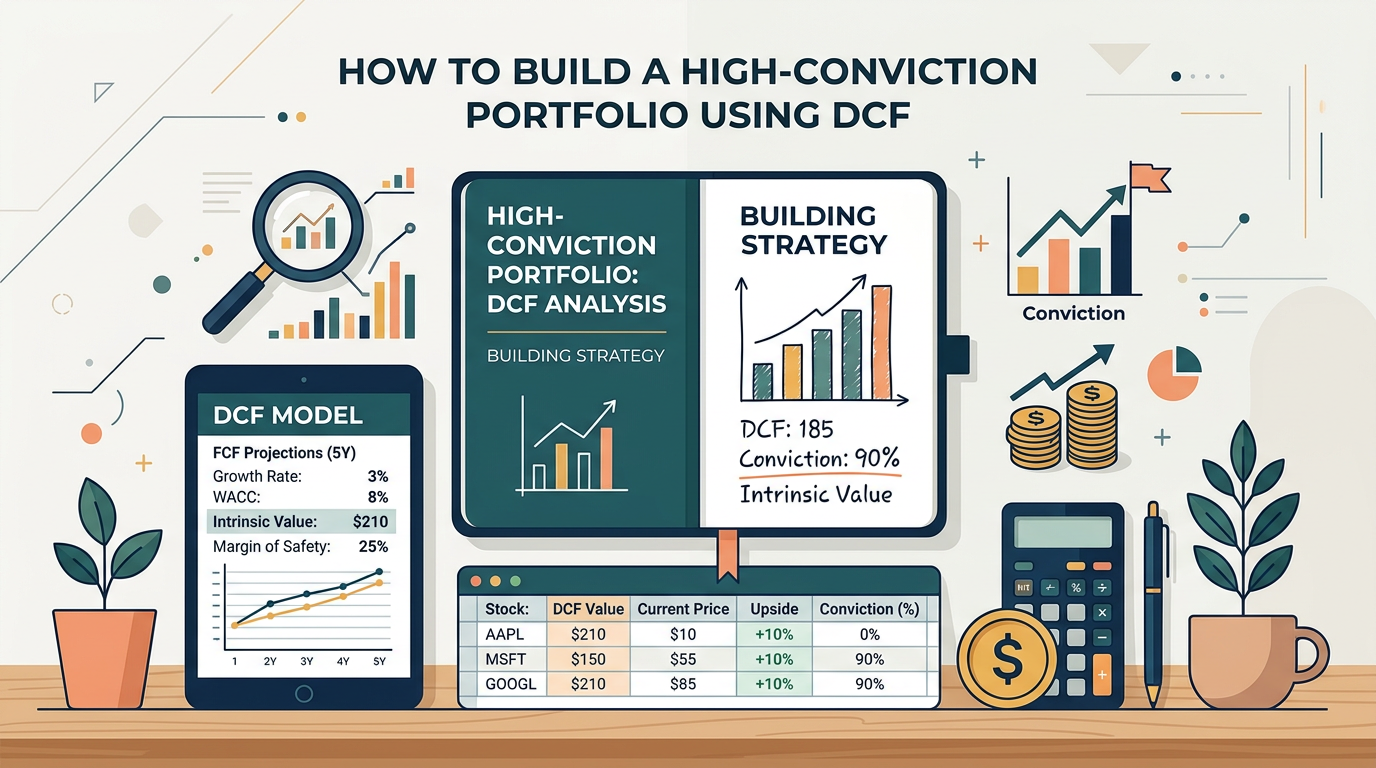
How to Build a High-Conviction Portfolio Using DCF
Learn how retail investors can use portfolio DCF analysis to find undervalued stocks, size positions intelligently, and build a high-conviction value portfolio.
Intrinsic Alpha
Value Investing Research
Most retail investors either own too many stocks to matter or too few to survive a single mistake. The ones who build lasting wealth tend to operate somewhere in the uncomfortable middle — concentrated enough to outperform, diversified enough to endure. The tool that makes that balance possible is the discounted cash flow model.
This isn't a lecture about spreadsheets. It's a framework for how value investing actually works when you're allocating your own capital.
Why Most Retail Portfolios Underperform
The problem isn't access to information. Retail investors today can read the same 10-K filings, earnings transcripts, and analyst reports as any fund manager. The problem is decision architecture — having no systematic method for translating research into conviction, and conviction into position size.
Most retail investors do one of two things:
- Diversify reflexively: 40 positions with no clear thesis differentiation, averaging into mediocrity.
- Concentrate emotionally: Big bets on narratives, not numbers, with no defined downside anchor.
Portfolio DCF breaks both patterns. It forces you to answer a single, brutal question before every investment: What does this business need to do over the next decade to justify today's price — and do I believe it?
What Portfolio DCF Actually Means
A portfolio DCF framework means applying discounted cash flow analysis consistently across every position in your portfolio — not as a one-time calculation, but as a living lens that governs entry, sizing, and exit.
The core mechanics are simple:
Intrinsic Value = Sum of all future free cash flows, discounted back to present value, minus net debt
But the real power isn't in the formula. It's in how the outputs change your behavior:
- Entry: You only buy when the market price implies a discount to your intrinsic value estimate.
- Sizing: Larger discounts justify larger positions.
- Exit: When price converges to intrinsic value, the thesis is complete — regardless of narrative.
Building the Framework: Three Layers of Analysis
Layer 1 — Estimate the Base Case
Start with the most probable scenario for the business over the next 10 years. Use recent free cash flow as the starting point, apply a realistic growth rate anchored to historical performance and competitive dynamics, then discount at a rate that reflects the business's risk profile.
For most stable businesses, a discount rate between 9% and 12% is appropriate. For faster-growing, less predictable businesses, push it toward 14–16%.
Key inputs to stress-test:
- Revenue growth rate (years 1-5 vs. years 6-10)
- Free cash flow margin trajectory
- Terminal growth rate (default conservatively to 3%)
- Net debt or net cash position
Layer 2 — Run the Bear and Bull Scenarios
A single intrinsic value estimate is a false anchor. The honest output of a DCF is a range of outcomes, not a number.
Run three versions:
| Scenario | Growth Assumption | Discount Rate | Output |
|---|---|---|---|
| Bear | Half of historical average | +2% premium | Low-end intrinsic value |
| Base | Historical average | Standard | Mid-point estimate |
| Bull | Management guidance realized | Standard | High-end intrinsic value |
If current market price is below your bear-case intrinsic value, the position deserves serious consideration. If it sits between bear and base, the margin of safety is moderate. If it exceeds your bull-case estimate, you are paying for optimism — and optimism does not compound.
Layer 3 — Size Positions to Your Conviction Range
This is where most value investors leave money on the table. They do the work, find the discount, then allocate 2% to the position because it feels risky to concentrate.
A rational position sizing framework based on portfolio DCF looks like this:
- Price 30%+ below bear-case intrinsic value → 8–12% of portfolio
- Price 15–30% below base-case intrinsic value → 4–8% of portfolio
- Price near base-case intrinsic value → watchlist only, no new allocation
- Price above bull-case intrinsic value → consider trimming existing position
This is not reckless concentration. It is disciplined asymmetry — sizing up when evidence supports it, and doing nothing when the math doesn't.
The Reverse DCF: Reading What the Market Believes
Here is the counter-intuitive insight most retail investors miss: you don't need to predict the future to use DCF well. You only need to decide whether the market's implied prediction is reasonable.
A reverse DCF inverts the model. Instead of estimating intrinsic value from assumed growth rates, you ask: given today's stock price, what growth rate does the market need to assume for the next 10 years to justify this valuation?
If the answer is 25% compounding free cash flow growth — for a mature, slow-growth consumer business — you know the market has priced in heroic assumptions. You don't need a better forecast. You just need to recognize the asymmetry is unfavorable.
Conversely, if the reverse DCF implies the market is pricing in zero or negative growth for a structurally sound business with a clean balance sheet, the bar for outperformance is low. That is where value investing lives.
Capital Allocation: The Variable Most Investors Ignore
DCF models project free cash flow — but free cash flow does nothing on its own. What management does with it determines whether intrinsic value per share grows or stagnates.
When building your portfolio DCF framework, evaluate management's capital allocation track record explicitly:
- Dividends: Reliable signal of cash generation confidence, but limits reinvestment optionality.
- Buybacks: Value-accretive only when done below intrinsic value. Buybacks above intrinsic value destroy shareholder value — a fact many management teams ignore.
- Acquisitions: Statistically, most destroy value. Scrutinize the return on invested capital for any major acquisition.
- Reinvestment at high ROIC: The most powerful compounder. A business that earns 20%+ ROIC on reinvested capital should retain earnings, not distribute them.
Poor capital allocators can make a cheap stock cheaper. Great capital allocators create intrinsic value faster than the market recognizes it. Know the difference before you size the position.
How Many Positions Does a Rational Portfolio Need?
This is the question every retail investor eventually confronts, and the honest answer depends on how much time you can dedicate to research.
A genuine value investing framework with portfolio DCF at its core supports:
- 10–15 positions: Optimal for most active retail investors. Enough diversification to absorb single-position errors, concentrated enough that your best ideas move the needle.
- Fewer than 10: Acceptable only if your research depth is institutional-grade and your temperament is genuinely indifferent to short-term drawdowns.
- More than 20: At this point, you are indexing with extra steps. Performance will regress to the mean minus your research costs.
The goal is not diversification for its own sake. The goal is maximum capital allocated to your highest-conviction, highest-margin-of-safety positions.
When to Sell: The Exit Discipline That Protects Compounding
Knowing when to sell is harder than knowing when to buy. The portfolio DCF framework provides three rational sell triggers:
- Price converges to intrinsic value: The thesis is complete. Holding above intrinsic value is speculation, not value investing.
- The original thesis is broken: If the business deteriorates in a way that structurally lowers future cash flows — not just a bad quarter — your intrinsic value estimate must be revised downward.
- A better opportunity appears: If a new position offers a 40% discount to intrinsic value and your current holding offers 5%, capital should migrate. Opportunity cost is a real cost.
Avoid selling positions simply because they have risen. If the business has compounded its intrinsic value faster than the price has risen, the discount may persist even after a large price gain.
Managing the Psychological Gap
The most dangerous gap in value investing is not between price and intrinsic value — it is the gap between what you know intellectually and what you do emotionally.
A portfolio built on DCF analysis will underperform the market for stretches of 12 to 36 months. Cheap stocks stay cheap. Narratives drive prices further from fundamentals before mean reversion begins. This is not a failure of the framework. It is the friction that makes the reward available.
The investors who extract value from portfolio DCF are not the ones with the best models. They are the ones who built a process they can hold through discomfort without abandoning it.
Document your thesis. Record your intrinsic value estimate and the assumptions behind it. Set a scheduled review cadence — quarterly is sufficient. Let the discipline carry you through the noise.
Key Takeaways for Retail Investors
- Portfolio DCF is a process, not a prediction. Use it to define the range of rational outcomes, not a precise number.
- Reverse DCF reveals market expectations. You do not need to out-forecast the market — you need to spot when its expectations are unreasonable.
- Position sizing is where conviction becomes capital. Larger discounts deserve larger allocations.
- Capital allocation quality determines whether intrinsic value grows. A cheap bad business is not a value investment.
- Sell when the thesis is complete or broken. Not when the market turns negative on the name.
The retail investor's edge is not information or speed. It is patience, rationality, and the willingness to remain concentrated in high-quality businesses purchased at a discount — for as long as the math supports it.
All intrinsic value estimates involve uncertainty and subjective assumptions. This article is for educational purposes and does not constitute financial advice. Past performance of any valuation framework does not guarantee future results. Always conduct independent research before making investment decisions.